
Planning a long-distance road trip across Australia requires a significant amount of preparation. Most drivers maintain a familiar checklist before hitting the highway, carefully testing their tyre pressure, verifying engine oil levels, checking coolant reservoirs, and ensuring the spare wheel is fully functional. Yet, even the most meticulous travellers frequently overlook one of the most critical structural components of their vehicle: the glass. A clear view of the road is essential for safety, but the windscreen does far more than keep the wind out of your face.
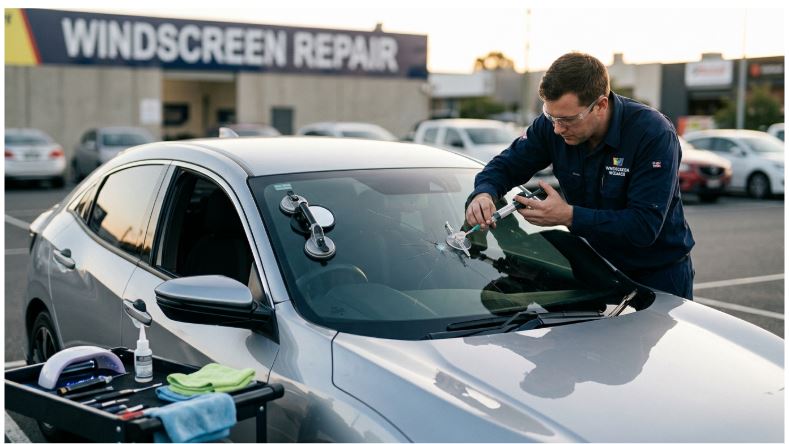
When you are travelling at high speeds on regional highways, minor imperfections in your glass can quickly become major safety hazards. Booking a professional windscreen chip repair before you set off is a simple, proactive step that prevents a minor blemish from escalating into a catastrophic structural failure mid-journey. Understanding how the physical stresses of highway driving interact with compromised glass can help you avoid expensive emergency callouts and keep your family safe on the open road.
[Protocol 1 of 3: Assessing Thermal Stress Limits]
The Australian climate is notorious for its extreme temperature shifts, and these rapid fluctuations put immense physical strain on automotive glass. When your vehicle sits parked under the hot summer sun, the glass expands naturally. The moment you step into the cabin and turn the air conditioning to its maximum setting, the sudden drop in temperature causes the glass to contract rapidly.
If your windscreen is completely intact, it can easily handle this thermal movement. However, if there is a tiny stone chip present, this constant expansion and contraction concentrates physical stress directly at the weakest point of the glass. The rapid temperature swing acts like a wedge, forcing the microscopic fractures inside the chip to spread outward, turning a small, repairable spot into a massive crack that spans the entire width of your screen.
Road-Ready Rule: Always address small glass blemishes before exposing your vehicle to extreme temperature variations or running the cabin air conditioning on high.
[Protocol 2 of 3: Managing Structural Vibrations]
Driving on urban streets at low speeds is relatively gentle on a vehicle’s bodywork. Regional highways and unsealed country roads, however, present a completely different set of physical challenges. Travelling at one hundred kilometres per hour exposes your vehicle to continuous, high-frequency vibrations from rough bitumen, expansion joints, and loose gravel.
Every bump, pothole, and sudden vibration sends shockwaves directly through your vehicle’s frame, which are then absorbed by the windscreen. A compromised piece of glass lacks the structural integrity to disperse these forces evenly. Over several hours of continuous driving, these constant micro-impacts will steadily weaken the area surrounding a stone chip, causing it to suddenly spiderweb without warning when you hit a bump or a corrugated stretch of road.
Road-Ready Rule: Inspect your glass for tiny impacts before driving on high-speed highways or rough country roads where continuous vibration is inevitable.
[Protocol 3 of 3: Preserving Safety Camera Alignment]
Modern vehicles are equipped with highly sophisticated safety systems, often referred to as Advanced Driver Assistance Systems. These features, which include lane-keep assist, autonomous emergency braking, and adaptive cruise control, rely on cameras and sensors mounted directly behind your rearview mirror, looking straight through your windscreen.
If a stone chip is left to crack across this specific zone, it can distort the camera’s field of view, causing your safety systems to malfunction or shut down completely. Furthermore, if a crack spreads to the point where the entire windscreen must be replaced, the forward-facing camera must undergo a complex electronic recalibration process to ensure it reads the road markings accurately. Resolving a chip early prevents this technological disruption, keeping your driving aids active and aligned.
Road-Ready Rule: Ensure the glass surrounding your camera sensors remains completely clear and undamaged to maintain the accuracy of your safety systems.
Taking the time to inspect your vehicle’s glass before a long journey is a practical habit that protects both your holiday budget and your peace of mind. By addressing minor stone chips early, you preserve the structural strength of your vehicle, protect your advanced safety technology, and guarantee a clear, uninterrupted view of the spectacular Australian landscape ahead.